Switching supplement manufacturers means transferring more than a Supplement Facts panel. A new partner needs enough authorized formula, quality, packaging, and production information to assess whether it can make the product consistently, while your team plans inventory and approves any changes.
Start with ownership and a controlled document inventory, then compare the new manufacturer’s proposed materials, process, testing, and release plan against the current product. CPack’s powder supplement manufacturing and custom gummy manufacturing pages illustrate why the questions depend on format: a powder’s flow and moisture behavior differ from a gummy’s texture and stability.
What should you do before switching supplement manufacturers?
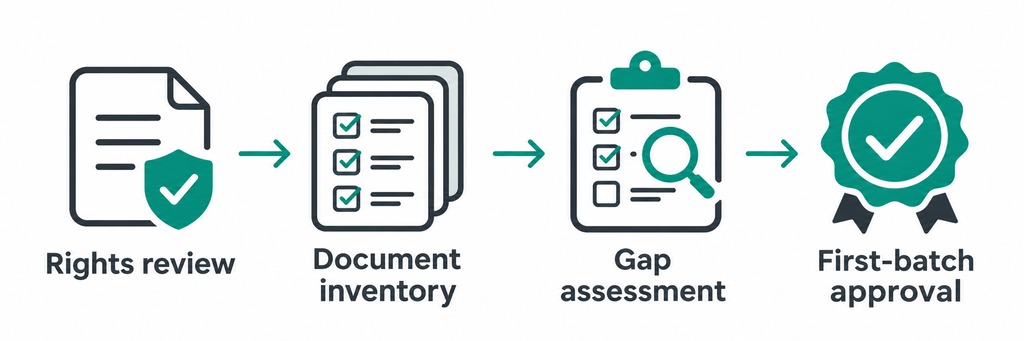
Establish what you can transfer before asking for a firm production plan. Gather the current agreement, amendments, formula and packaging approvals, and a list of open orders. Ask counsel to review ownership, confidentiality, termination, outstanding obligations, and rights to use or disclose technical information.
A label may identify ingredients and serving amounts, but it is not a complete manufacturing formula. Stock or private-label formulas may belong to the manufacturer; a brand-owned custom formula may have restrictions or third-party licensed ingredients.
Do not assume rights from who paid for development. If the recipe cannot be released, discuss a permitted reformulation and assess its label and commercial consequences.
Assign one owner on each side to maintain a version-controlled transfer log: document, revision, owner, permitted recipient, status, and unresolved question. Share confidential files under an appropriate agreement and secure access. Confirm which records the outgoing manufacturer will provide and whether a summary or controlled review can substitute for proprietary records.
Build the formula and specification package
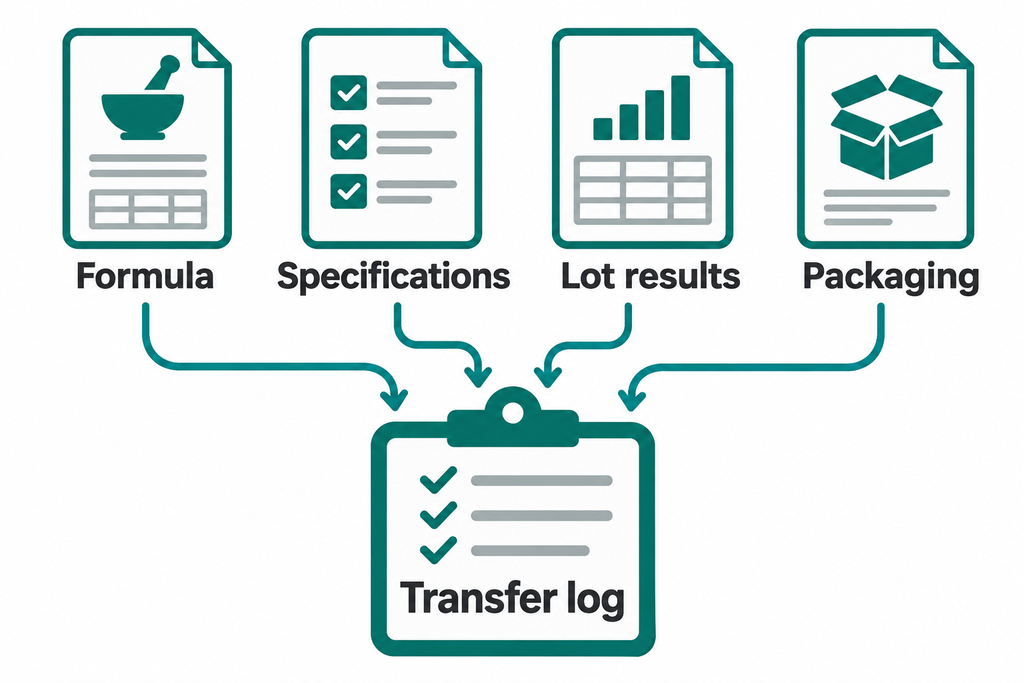
The new manufacturer needs the approved target and the details that can change the result. Request the current quantitative formula, including ingredient forms, amounts per serving and batch, excipients, overages and their rationale, and any approved substitutions. Identify supplier, grade, standardized constituents, allergens, and relevant material specifications where available.
Provide product specifications and acceptance limits for identity, strength, composition, and applicable contamination limits, along with methods and sampling plans. Include target serving size, fill weight, appearance, flavor, texture, and packaging configuration. Identify which requirements are contractual and which reflect applicable regulations; a certificate of analysis is a result for a particular lot, not the specification itself.
Send representative recent lot certificates, deviations, complaint trends, stability data and test methods where you have rights to share them. Note missing records instead of treating them as passing results. The incoming manufacturer must assess whether methods, suppliers, equipment, and batch sizes are suitable; it may need its own manufacturing records rather than simply adopting the former facility’s instructions.
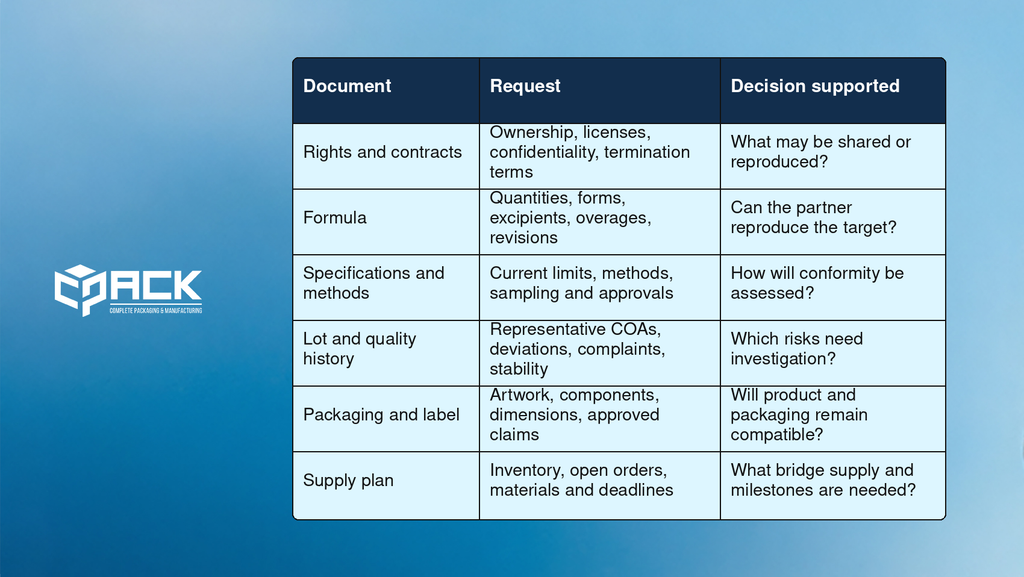
Transfer checklist: what to request and why
Use this handoff inventory to assign an owner and identify gaps before a quote becomes a production commitment.
Compare the proposed product, not just the price
Ask the incoming manufacturer for a written gap assessment. Compare each ingredient source and grade, excipient, manufacturing step, finished-product specification, method, package component, and label revision with the approved baseline. Record the proposed change, reason, impact, evidence needed, and approver before implementing it.
A different supplier or process can affect taste, flow, fill, stability, or testing even when the ingredient names look identical. Agree on representative samples or a development run where appropriate, its cost and acceptance criteria, and what happens if it fails. A pilot can inform the decision; it does not replace required production controls or prove shelf life.
For example, a powder that flows differently may need a revised process or excipient. Decide whether the change is acceptable, whether labeling must change, and which stability or compatibility work is appropriate before approving it. For gummies, include shape, weight, flavor, texture, and packaging in the comparison. CPack’s guide to supplement packaging changes explains why a new package may need its own quality review.
Set quality and release responsibilities
A quality agreement should name who approves specifications, qualifies suppliers, handles testing, investigates deviations and complaints, controls changes, retains records, and makes release decisions. Define notification timing and escalation, but do not assume the agreement transfers away legal responsibilities.
FDA’s dietary supplement CGMP guide explains that a distributor using a contract manufacturer must know what and how manufacturing activities are performed so it can make decisions about conformity and release. Confirm applicable requirements with qualified regulatory counsel and quality staff; the details depend on each party’s activities.
Agree on the finished-product testing plan: tests, methods, acceptance limits, laboratory, sampling, certificates, out-of-specification investigations, and disposition. A historical passing certificate is useful context, not proof that the first new batch passes. Review the new batch documentation and authorized quality decisions before distribution.
Protect supply during the handoff
Build a schedule backward from the date usable inventory is needed. Include rights review, document collection, feasibility, sourcing, artwork approval, development or trial work, production, testing, disposition, and delivery. Put owners and dependencies beside each milestone, and identify the latest decision date for a bridge order.
Compare on-hand stock, demand forecast, expiry dates, open purchase orders, and the outgoing manufacturer’s final production and shipment commitments. Avoid relying on an unconfirmed date. Agree on contingencies for delayed ingredients, packaging, testing, or failed acceptance, and confirm whether unused materials and artwork can be transferred or must be disposed of.
For a comparable quote, provide the format, formula status, expected order quantity, packaging, desired timing, and testing needs. Clarify whether minimums refer to bottles, individual capsules, kilograms, or another unit. A finished-unit minimum and a manufacturing batch size are not necessarily interchangeable.
Approve the first batch and close the transfer
Before authorizing production, document the final formula and label versions, approved suppliers, specifications, packaging, test plan, change-control process, and commercial terms. Confirm who can approve a deviation and who will review the batch record and release documentation.
After the first batch, compare the agreed results and product characteristics against the baseline and acceptance criteria. Investigate any mismatch before release, retain the relevant records, and update the transfer log with decisions and owners. Close the project only when outstanding changes, materials, and future order responsibilities are assigned.
Frequently asked questions
Possibly, but first check the contract and any license or confidentiality restrictions. A stock formula may be owned by the original manufacturer; discuss permitted alternatives with counsel and the prospective partner.
No. It usually does not disclose the complete quantitative manufacturing formula, excipients, processing instructions, or material specifications. Use the approved technical documents you are authorized to share.
Not necessarily. Different sources, equipment, processes, and packaging may affect the finished product. Define acceptable differences and review evidence and changes before approval.
The applicable responsibilities depend on each party’s activities and the law. Put the testing, review, investigation, and release workflow in writing, and have quality and regulatory advisers assess it.
Review termination terms and inventory exposure first. A documented transition and, where commercially feasible, a bridge supply can reduce the risk of a gap, but no schedule is guaranteed.
Request a quote from CPack to discuss a transfer. Bring your format, authorized formula documents, quantity, packaging requirements, and target timing to a manufacturing conversation. Identify the missing records and decisions upfront so the proposed scope can be evaluated.